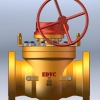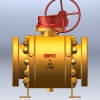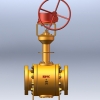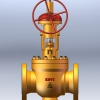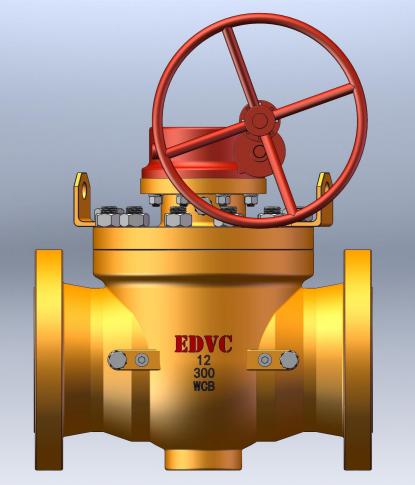
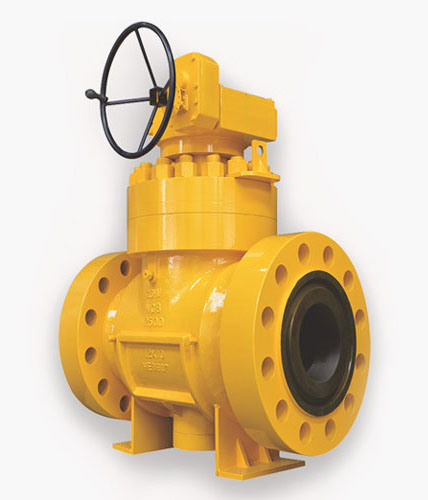
Top Entry Trunnion Ball Valve
Features
Top Entry Ball Valves are mainly used in pipelines. It is directly connected to the pipeline by welding. Although the general features are same with Top Entry Full Welded or Top Entry Split Body Ball Valves, the biggest difference is that the body cavity can be accessed by removing the cover without extracting the valve from the line. With some special maintenance tools, ball and seatrings can be removed and repaired or spare parts can be changed. This operation does not require wide area around the valve by the way it can be used easily in limited access area. Other features are similar with Full Welded and Split Body Ball Valves.
Top Entry Trunnion Ball Valves: Top Entry Trunnion ball valves have additional anchoring at the top and the bottom of the ball. Those two trunnions absorb the thrust generated by the line pressure, preventing excess friction between the ball and seats. Therefore, operating torques stay low even at full working pressures.
Anti-Blow-Out Stem Design: Stem design of EDVC top entry ball valves is of blow-out proof which prevents ejection of stem when the valves is under pressure. This design is in fully compliance with API 6D requirements.
Antistatic Device: All EDVC top entry ball valves are equipped with an antistatic device which creates a ground path and ensures an electrical conductivity through all metallic valve components.
Fire Safe: EDVC top entry ball valves are fire safe by standard design. Fire safe tests were carried out and certified according to API 607.
Mounting Flange: EDVC top entry ball valves are provided with ISO mounting flanges for actuators. Their design is in fully compliance with ISO.
Seat Seal System: EDVC top entry ball valves provide spring supported soft seats as a standard. Seats are pushed against the ball surface by springs and provide a tight seal even if at low line pressure when the piston effect is not significant yet. During operation, in addition to the force generated by seat springs, line pressure pushes the seat ring against the ball providing tighter shutoff.
Top Entry Ball Valve vs Side Entry Ball valve
Design and Access
Top-Entry Ball Valve:
The ball and seats are accessible from the top of the valve body.
To perform maintenance, you remove the bonnet (top cover) without removing the valve from the pipeline.To perform maintenance, you remove the bonnet (top cover) without removing the valve from the pipeline.
Advantage: Top Entry Ball Valve is easier maintenance in systems where removing the valve is difficult.
Side-Entry (Split-Body) Ball Valve:
The body is usually split into two halves (or three for trunnion-mounted).
To access the ball, must remove the valve from the pipeline, and split the body.
Advantage: Simple design, robust sealing.
Disadvantage: Maintenance is more time-consuming because need to disconnect the valve from the pipeline.
Maintenance
Top-Entry-Ball Valve:
Can be maintained in-place; you can replace seats, seals, or inspect the ball without shutting down the pipeline completely.
Common in high-pressure or large-diameter valves, where removal is challenging.
Side-Entry-Ball Valve:
Requires pipeline shutdown and valve removal.
Typically better for smaller valves or where the system can tolerate downtime.
Sealing and Leakage
Top-Entry-Ball Valve:
Can incorporate live-loaded packing and replaceable seats.
Easier to ensure proper sealing because maintenance can be performed more frequently without full removal.
Side-Entry-Ball Valve:
Solid, reliable design for static systems.
Less convenient if leaks occur because you need to remove the valve.
Previous: There is no more.